Table of Contents
- Why AI Crawlers Skip Bloated CMS Sites
- What Zero-JavaScript Architecture Means in Astro
- How Astro Islands Handle Interactive RFQ Tools
- WordPress vs React SPA vs Astro Benchmarks
- Why Sub-Second Speed Drives AI Citations
- Keeping Specs and JSON-LD Synchronised
- 5-Step B2B Migration Blueprint to Astro
- Conclusion
- Frequently Asked Questions
Astro framework B2B SEO uses a zero-JavaScript-by-default build architecture that compiles product specifications, capacity tables, and JSON-LD schema into pure static HTML before deployment. Pages load in under one second on mobile networks and let non-rendering AI crawlers like GPTBot and ClaudeBot extract every vendor fact on the first HTTP request.
Open Chrome DevTools on almost any Indian manufacturer's website today and inspect the Network tab. Before a procurement engineer in Pune or a sourcing agent in Germany sees a single material grade, the browser has to download twenty-six stylesheets, four tracking pixels, a slider script, a pop-up plugin, and over a megabyte of JavaScript. On a desktop fibre connection in an agency boardroom, that bloat hides behind fast hardware. On a 4G phone inside an industrial estate in Pithampur or Chakan, the screen stays white for four seconds.
Human impatience is only half the damage. When a buyer asks ChatGPT, Claude, or Perplexity to shortlist ISO 9001 CNC machining suppliers or specialty chemical exporters, live retrieval bots fetch candidate pages under strict latency and token budgets. Most AI crawlers don't run a headless browser to execute client-side JavaScript. If your tolerances sit behind a script-rendered tab, or at the bottom of a 1.8 MB page-builder document, the crawler times out or truncates the file. You lose the shortlist before your sales team ever knows an enquiry existed.
At Square Root SEO, we moved every client Digital Factory, Digital Office, and Digital Showroom onto Astro for this exact engineering reason. Strong Astro framework B2B SEO eliminates client-side bloat at the compiler level rather than trying to patch a slow CMS with caching plugins. This guide breaks down why legacy stacks fail AI extraction, how zero-JavaScript Islands work in production, and how established B2B companies can migrate without losing existing search equity.
Why Do AI Crawlers Skip Bloated CMS and JavaScript-Heavy B2B Websites?
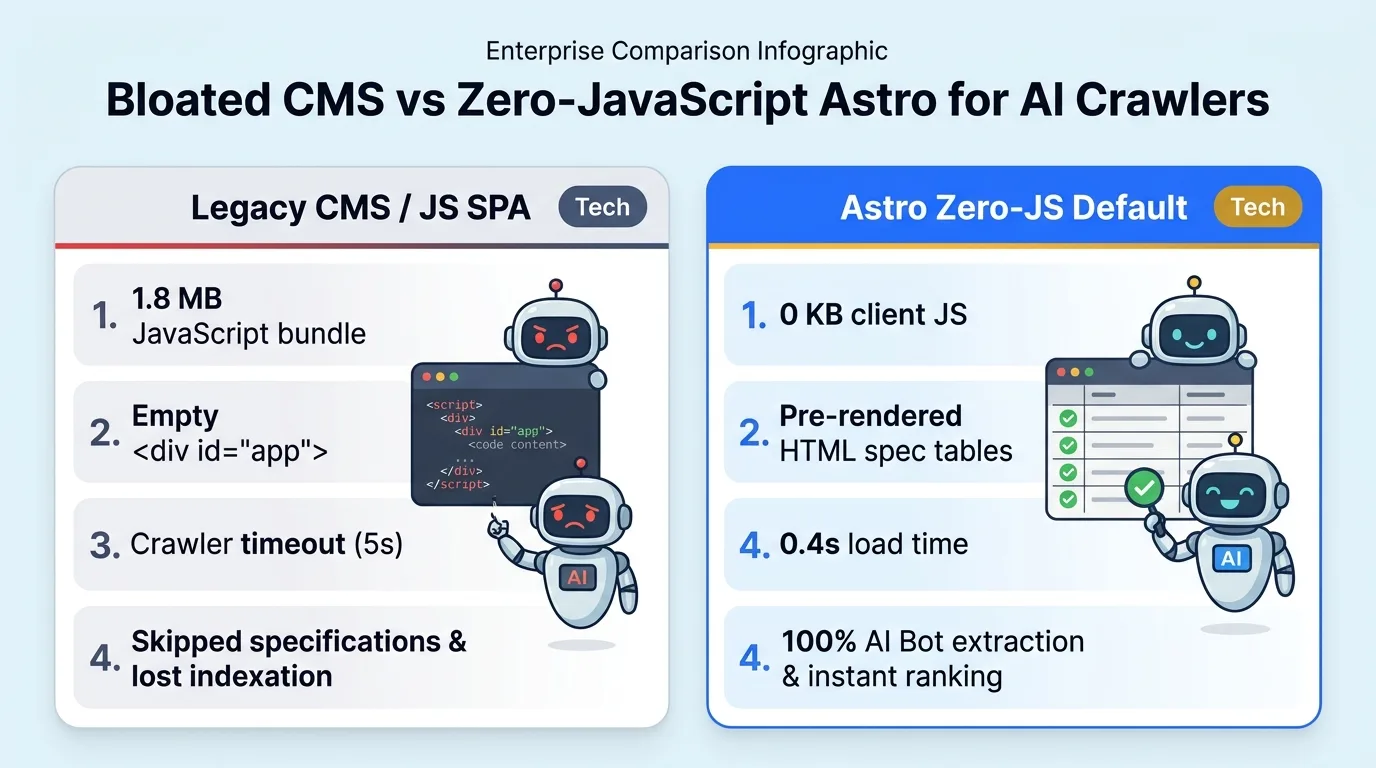
AI crawlers such as GPTBot, ClaudeBot, and PerplexityBot fetch raw HTML over HTTP without executing client-side JavaScript bundles. On bloated CMS pages or single-page applications, crawlers encounter empty root containers, slow database TTFB, or thousands of nested layout divs that exhaust token budgets before product specifications appear.
For fifteen years, technical SEO teams built websites with a single bot in mind: Googlebot. Because Google invested heavily in a Web Rendering Service backed by headless Chromium, developers grew comfortable shipping heavy JavaScript frameworks and visual WordPress page builders. Googlebot would eventually render the page, even if its second-wave rendering queue delayed indexing by several days.
AI search broke that safety net. The crawlers powering generative procurement research, including OpenAI's GPTBot and OAI-SearchBot, Anthropic's ClaudeBot, and PerplexityBot, operate on fundamentally different economics. Running headless Chromium to execute JavaScript across billions of URLs costs roughly ten to twenty times more compute than parsing raw HTTP responses. As a result, almost every major AI crawler fetches the initial HTML payload, strips markup tags, and reads only what exists in the raw server response.
When we run raw HTTP audits on B2B websites across India, two failure patterns show up repeatedly. The first is the Single-Page Application trap: a software vendor or modernised manufacturer hires an agency that builds the entire frontend in client-side React or Vue. To a human in Chrome, the catalogue looks sleek. To ClaudeBot, the entire product page consists of a single empty div tag and a script reference. Zero specifications get indexed.
The second failure is visual page-builder bloat on legacy CMS platforms. Elementor, Divi, and WPBakery wrap a simple six-row specification table inside fourteen layers of nested layout containers, inline SVG icons, and WooCommerce cart scripts. By the time a parser strips out 900 kilobytes of navigation menus and shortcode wrappers, the actual machining tolerances sit past the truncation threshold of the retrieval pipeline. We examine the parser side of this bottleneck in our breakdown of how AI tools extract vendor data.
What Is Zero-JavaScript Architecture and Why Does Astro Lead B2B SEO?
Zero-JavaScript architecture means the web framework compiles components on the build server into static HTML and CSS, shipping zero kilobytes of client-side JavaScript by default. Astro leads B2B SEO because developers can author modular components in familiar syntax while delivering pure, pre-rendered semantic markup to browsers and crawlers.
A common misconception among manufacturing directors and IT managers is that a fast static website must look plain or be hand-coded like a 1998 brochure. Astro separates the developer experience from the browser payload. On the engineering side, your team writes clean, reusable components for specification tables, certification badges, plant capacity cards, and author bios using TypeScript, Astro templates, or even React and Svelte components.
The difference happens at build time. Traditional JavaScript frameworks like Next.js or Nuxt ship your HTML alongside a substantial JavaScript runtime that 'hydrates' the entire page in the visitor's browser so every element becomes interactive, even paragraphs of static text that never change. Legacy PHP platforms like WordPress assemble the page dynamically on every visit by querying a MySQL database, running thirty plugin hooks, and stitching together a theme template while the buyer waits.
Astro refuses both taxes. During deployment, Astro executes all data fetching, template logic, and schema generation ahead of time, outputting pure HTML and scoped CSS files. It then strips out every line of component JavaScript before publishing those files to global Edge CDN nodes. Look at the exact difference in what an AI crawler receives over the wire:
<!-- What GPTBot receives from a client-rendered React SPA -->
<body>
  <div id="root"></div>
  <script src="/assets/vendor-bundle-94f8a.js" defer></script>
</body>

<!-- What GPTBot receives from an Astro zero-JavaScript B2B page -->
<body>
  <main>
    <h1>SS 316L Hydraulic Fittings: Pressure Rated to 420 Bar</h1>
    <div class="snapshot-block">
      <p>ISO 9001:2015 certified CNC hydraulic fittings machined in Pithampur...</p>
    </div>
    <table>
      <caption>Dimensional Tolerances and Working Pressure by Thread Series</caption>
      <thead>
        <tr><th scope="col">Part Series</th><th scope="col">Tolerance (mm)</th><th scope="col">Max Pressure (Bar)</th></tr>
      </thead>
      <tbody>
        <tr><th scope="row">HF-316-08</th><td>0.02</td><td>420</td></tr>
      </tbody>
    </table>
  </main>
</body>
Notice what the machine sees in the second block. There is no hydration script, no virtual DOM payload, and no database query delay. The heading, the 50-word factual summary, and the scoped HTML table headers arrive in the very first TCP packet. That architectural shift is why we treat the codebase itself as the foundation of an owned B2B Digital Asset rather than a disposable marketing theme. If you are still weighing custom asset ownership against directory listings or template builders, read our analysis of owned versus rented B2B digital asset strategies.
How Does Astro Islands Architecture Handle Interactive RFQ Tools Without Slowing Pages?
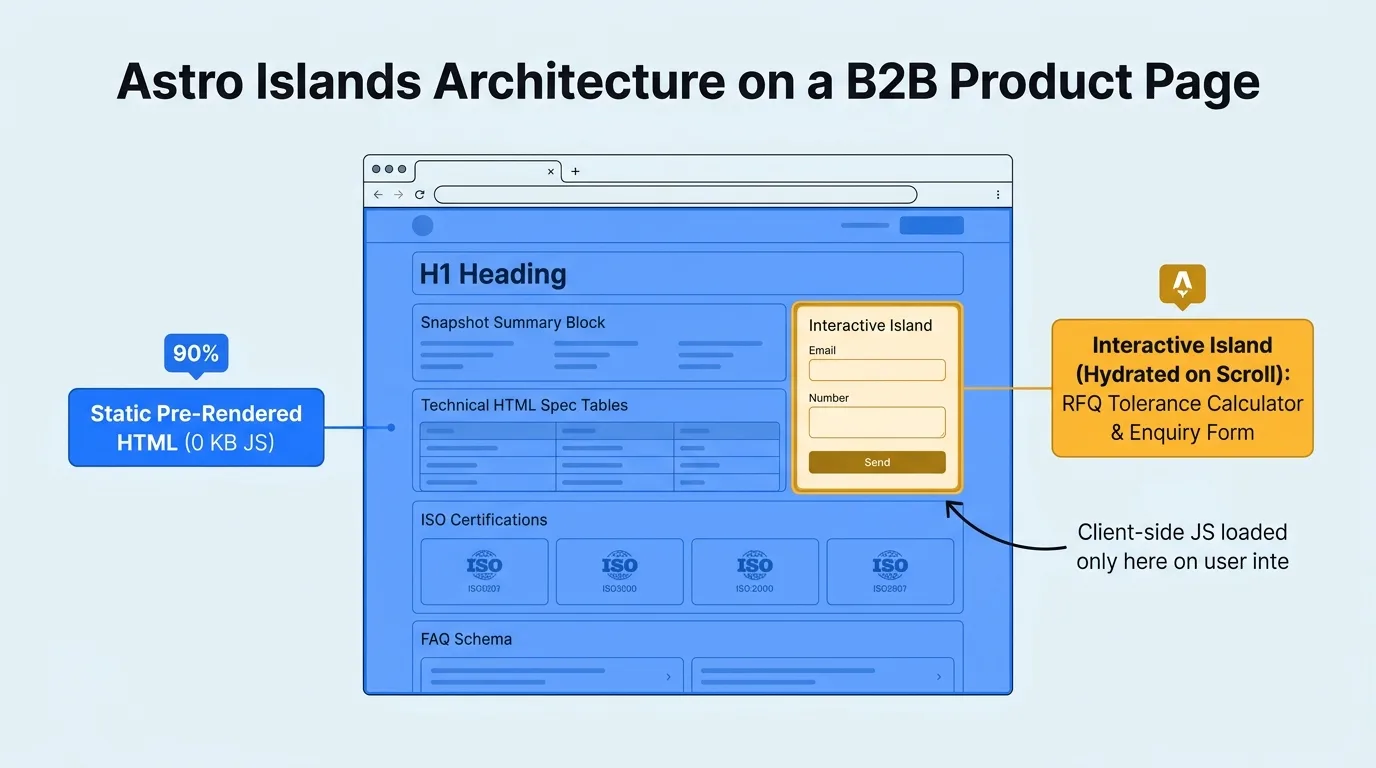
Astro Islands architecture renders the entire page as zero-JavaScript static HTML while isolating interactive widgets, such as RFQ calculators or CAD viewers, into independent client islands. Each island loads its own small script asynchronously on scroll or idle, keeping initial load times under a second without sacrificing buyer utility.
Whenever we explain zero-JavaScript defaults to an industrial equipment maker or a chemical exporter, the first question is practical: 'What happens to our enquiry form, our coil weight calculator, or our interactive product filter?' B2B websites still need functional tools. Engineers calculate flow rates, architects filter marble finishes by thickness, and procurement teams upload engineering drawings.
Astro solves this through Islands Architecture, originally pioneered for high-performance e-commerce and refined in Astro into explicit client directives. Think of a B2B product page as an ocean of static facts. Your H1 title, your ISO and BIS certification numbers, your dimensional tolerance table, your test reports, and your FAQ accordion text never need a JavaScript framework to sit on a screen. On a typical industrial product page, 90% to 95% of the surface area is pure reference information.
Instead of wrapping that entire page inside a 700 KB React runtime just to power one calculator at the bottom, Astro treats the calculator as an isolated island. Everything outside that box stays zero-JS static HTML. For the widget itself, the developer attaches an explicit directive controlling exactly when its script is allowed to touch the network:
- No directive (Default): Compiles to pure HTML and CSS with zero client JavaScript. Use this for specification tables, capacity charts, certification records, case studies, blog articles, and JSON-LD schema blocks.
- client:visible: Downloads and hydrates component scripts only when the buyer scrolls the widget into the viewport. Use this for below-the-fold RFQ forms, freight estimators, and alloy weight calculators.
- client:idle: Waits until the browser finishes painting the main document and enters an idle period before loading scripts. Use this for header search modals or WhatsApp enquiry triggers.
- client:load: Hydrates immediately on page load. Reserve this strictly for above-the-fold configurators where interaction is the sole purpose of the URL.
Here is how a real B2B specification page combines zero-JS static tables with a lazy-hydrated RFQ tolerance calculator in twenty lines of Astro code:
---
// src/pages/products/hydraulic-fittings.astro
// Runs 100% at build time on the server. Ships 0 KB JS for static components.
import BaseLayout from '../../layouts/BaseLayout.astro';
import SpecTable from '../../components/SpecTable.astro';
import CertificationGrid from '../../components/CertificationGrid.astro';
import RfqToleranceCalculator from '../../components/RfqToleranceCalculator.jsx';
import { getEntry } from 'astro:content';

const product = await getEntry('products', 'ss-316l-hydraulic-fittings');
---

<BaseLayout title={product.data.title} schema={product.data.jsonLd}>
  <h1>{product.data.h1}</h1>
  <div class="snapshot-block"><p>{product.data.snapshot}</p></div>

  <!-- Pure static HTML: 0 KB client JavaScript, instant AI crawler parsing -->
  <SpecTable rows={product.data.specifications} />
  <CertificationGrid items={product.data.certifications} />

  <!-- Isolated Island: JS loads ONLY when a human scrolls to this calculator -->
  <RfqToleranceCalculator client:visible grades={product.data.alloys} />
</BaseLayout>
Because the Island hydrates only when scrolled into view (`client:visible`), two things happen simultaneously. A human buyer landing on the top of the page gets an instant 0.6-second load with zero main-thread blocking, and if they scroll down to calculate batch weights, the widget activates smoothly. Meanwhile, GPTBot or Googlebot reads the entire specification table and certification grid immediately without executing a single byte of calculator script.
How Does Astro Compare With WordPress and React SPAs on Real B2B Sites?
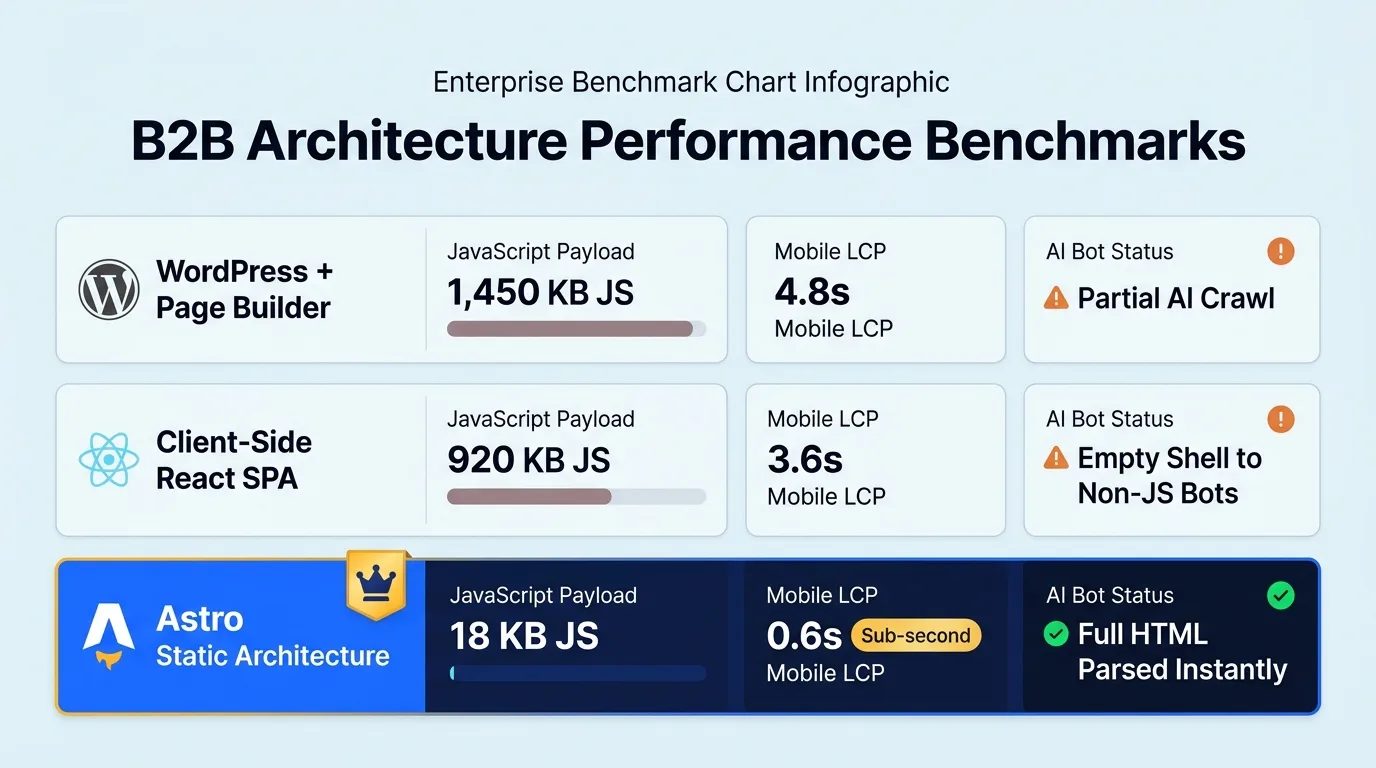
In Square Root SEO working benchmarks, legacy WordPress page-builder sites typically ship over 1,000 KB of JavaScript and reach 4 to 7 second mobile LCP, while client-side SPAs hide specifications from non-rendering bots. Astro builds typically ship under 25 KB of JavaScript, reach sub-second mobile LCP, and expose every spec in raw HTML.
Marketing agencies love debating frameworks in theory, so we prefer comparing real page weights. The table below summarises the ranges we see when auditing Indian industrial and professional service sites: CNC component makers, specialty chemical suppliers, natural stone exporters, and multi-partner CA practices. Treat the figures as typical ranges from our own working benchmarks, not an industry study, and measure your own domain with PageSpeed Insights and a raw curl request.
Alongside standard Core Web Vitals, we track an internal metric we call the Payload-to-Fact Ratio: how many kilobytes of HTML, CSS, and JavaScript a crawler must download to extract 100 words of verifiable commercial data (tolerances, capacities, grades, or regulatory citations). On bloated page builders that ratio is routinely several hundred kilobytes. On Astro Digital Factories it falls to roughly ten.
| Architecture Metric | Legacy WordPress + Page Builder | Client-Side React SPA | Astro Zero-JS Digital Asset |
|---|---|---|---|
| Default Client JS Payload | 950 KB to 1,850 KB | 650 KB to 1,200 KB | 0 KB to 22 KB (Islands only) |
| Median TTFB (Indian 4G) | 780 ms to 1,600 ms (PHP + DB) | 320 ms (HTML shell only) | 65 ms to 140 ms (Edge CDN HTML) |
| Mobile Largest Contentful Paint | 4.2 s to 6.8 s | 3.4 s to 5.1 s | 0.5 s to 0.9 s |
| Raw HTTP Visibility to GPTBot | Buried under 1,200+ DOM nodes | Empty div container (0% specs) | 100% specs in clean semantic HTML |
| Payload-to-Fact Ratio (SRS Metric) | 420 KB per 100 spec words | 310 KB per 100 spec words | 11 KB per 100 spec words |
| Plugin / Dependency CVE Surface | High (20 to 35 active plugins) | Moderate (runtime npm tree) | Near zero (static files on CDN) |
Look closely at the fifth and sixth rows. Security and maintenance rarely show up in SEO pitches, yet they destroy B2B compounding quietly. A WordPress manufacturing site running twenty-eight plugins suffers constant PHP version conflicts, WooCommerce database bloat, and recurring malware injections through outdated form plugins. Every time a security plugin misfires or a database connection stalls, crawlers hit 502 errors and drop pages from their index. Static Astro files sitting on an Edge CDN have no live database to hack and no PHP runtime to crash under traffic spikes.
Why Do Sub-Second Load Times Directly Increase AI Citations and Procurement Leads?
Live AI answer engines enforce strict per-domain retrieval timeouts of roughly one to three seconds when assembling real-time vendor shortlists. Sub-second Time to First Byte and clean semantic HTML ensure your pages finish downloading inside that window and preserve tight token proximity between specification headers and values.
Speed in 2027 is no longer just a tie-breaker in Google's traditional ranking algorithm. In live Retrieval-Augmented Generation (RAG), speed determines whether your page enters the model's context window at all. Think about what happens when a procurement head types a live query into Perplexity or ChatGPT Search: 'Find ISO 13485 certified medical injection moulding manufacturers in India with cleanroom Class 8 capacity.'
The user expects a synthesised comparison on screen within four or five seconds total. Within that tiny clock, the AI engine has to rewrite the query, search its index, dispatch live HTTP fetches to eight or ten candidate URLs, strip boilerplate HTML, chunk the text, and generate its response. If your server takes 1.9 seconds just to negotiate SSL, run PHP queries, and deliver the first byte of HTML, the retrieval orchestrator simply drops your connection and synthesises its answer from the six faster competitors that responded in 120 milliseconds.
Sub-second Astro pages win the second half of extraction as well: token proximity. Language models read documents sequentially as tokens. When an Astro page outputs a clean H2 heading, a 50-word snapshot paragraph, and a native HTML table without 800 lines of intervening script tags or div wrappers, the semantic relationship between 'Cleanroom Classification' and 'ISO Class 8' stays intact inside a single retrieval chunk. Pair that clean markup with HTML specification tables instead of static PDFs and a root-level llms.txt directory map for AI crawlers, and your technical data becomes effortless for machines to quote.
Human conversion follows the exact same physics. An overseas buyer in Stuttgart or Houston clicking through to verify your machining envelope expects immediate clarity. When every specification page transitions in 200 milliseconds without layout shifts or cookie-script freezes, engineering teams review four times as many product families per session and submit far higher-intent RFQ packages.
How Do Astro Content Collections Keep Specifications and JSON-LD Schema Synchronised?
Astro Content Collections validate product data against strict TypeScript schemas at build time. Because both the visible HTML specification table and the head JSON-LD blocks pull from one validated data file, manufacturers eliminate schema drift, broken units, and conflicting capacity claims that cause AI engines to distrust a vendor.
One of the quietest killers of B2B AI citations is data drift. On a typical CMS website, a marketing executive updates monthly production capacity from 80,000 units to 1,40,000 units inside a visual page builder, but forgets to update the hardcoded JSON-LD Product schema pasted into an SEO plugin box eighteen months earlier. When an AI parser sees 1,40,000 in the body text and 80,000 in structured data, confidence drops and both claims get discounted.
Astro eliminates this human error through Content Collections backed by Zod type validation. Instead of scattering specifications across visual blocks and separate SEO plugin fields, each product family or service blueprint lives in a structured data file validated at compile time:
// src/content/config.ts
import { defineCollection, z } from 'astro:content';

const products = defineCollection({
  type: 'data',
  schema: z.object({
    skuFamily: z.string(),
    materialGrade: z.string(),        // e.g. "ASTM A276 SS 316L"
    toleranceMm: z.number().positive(),
    monthlyCapacityUnits: z.number().int().positive(),
    isoStandard: z.string(),          // e.g. "ISO 9001:2015"
    leadTimeWorkingDays: z.number().int(),
  }),
});

export const collections = { products };
If someone accidentally types a string where a numeric tolerance in millimetres is required, or leaves out the ISO standard string, Astro stops the build in the terminal and points to the exact line before broken markup ever reaches your live domain. Even better, your page template reads `product.data.toleranceMm` once to render the visible HTML table cell and reads the exact same variable milliseconds later to populate your `Product`, `FAQPage`, and `SpeakableSpecification` JSON-LD blocks.
That single-source architecture makes scaling across dozens of industrial SKUs or professional service verticals clean and predictable. To see which JSON-LD types belong in that automated head stack, review our implementation guides on AI schema markup for B2B websites and Speakable and FAQPage schema for Position Zero.
How Can an Established B2B Business Migrate From WordPress to Astro Without Losing Rankings?
Migrating from WordPress to Astro without traffic loss requires locking your exact indexed URL structure, mapping 301 redirects at the CDN edge, converting plugin-trapped specifications into structured collections, generating matching JSON-LD schema, and verifying raw HTTP responses before switching DNS.
Established companies often hesitate to leave a slow CMS because they fear losing ten years of Google rankings overnight. That fear is justified when agencies treat a website rebuild as a visual redesign and casually change URL slugs from `/cnc-turned-parts/` to `/products/precision-turning/` without a redirect map. Traffic drops during migrations rarely come from changing the code framework; they come from breaking URLs, stripping content depth, or dropping canonical tags.
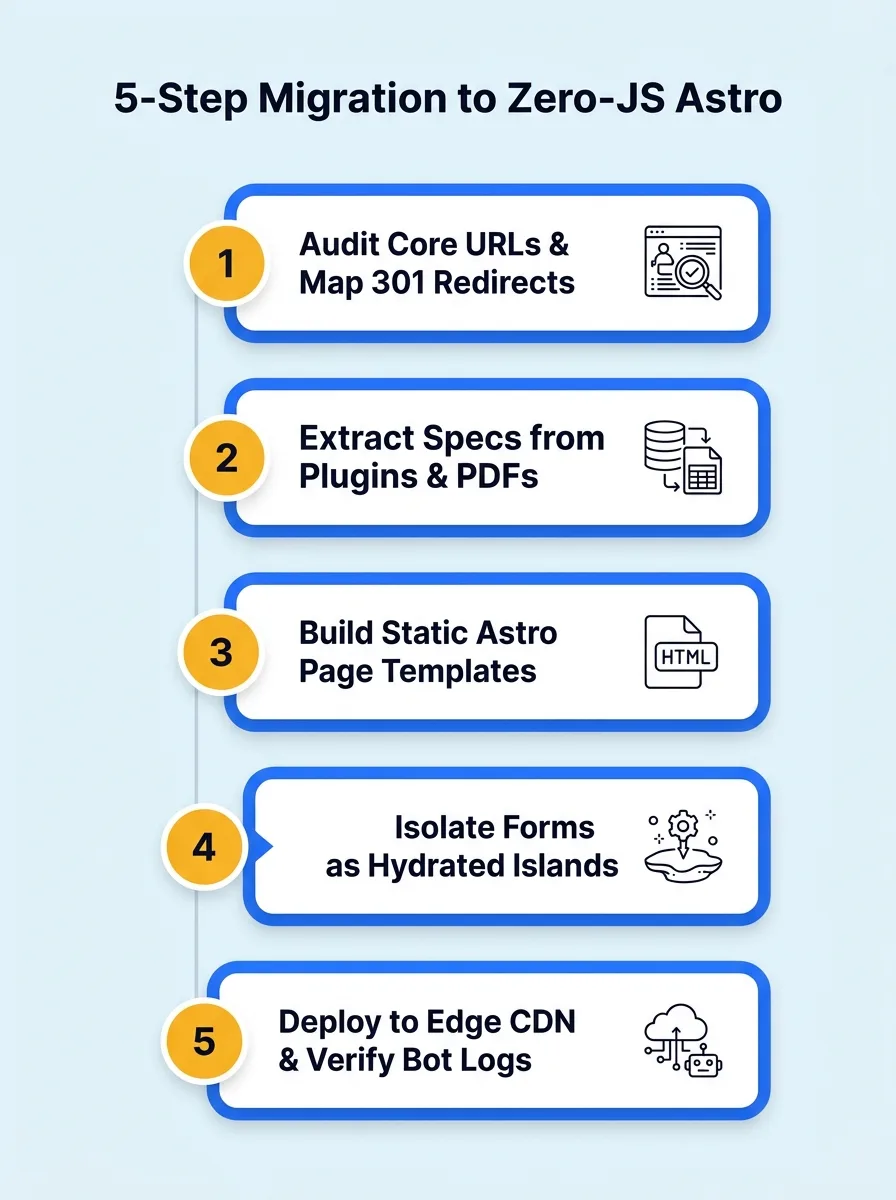
When we migrate a manufacturer, exporter, or advisory practice onto an Astro foundation, we run a strict five-step engineering sequence designed to preserve 100% of existing search equity while unlocking sub-second AI crawlability:
- Crawl and lock your URL inventory: Export every indexed URL from Google Search Console and your existing sitemap. Record exact slugs, trailing slash conventions, and current ranking queries so equity is never dropped through broken paths.
- Extract technical data out of page-builder shortcodes: Pull product tolerances, MOQs, machine lists, and certificate numbers out of Elementor widgets or PDF brochures into clean JSON or Markdown files inside Astro Content Collections.
- Build zero-JavaScript page templates with unified schema: Create semantic HTML templates using proper table headers, 40 to 60 word snapshot blocks, and automated BlogPosting, Product, and FAQPage JSON-LD generated from the same data fields.
- Isolate enquiry workflows into lightweight Islands: Rebuild bloated contact plugins as a single static HTML form backed by a serverless endpoint, hydrating client validation only when the form enters view.
- Deploy to an Edge CDN and audit raw crawler logs: Publish pre-built static files to Cloudflare Pages or Netlify, test raw HTTP responses with curl to confirm zero-JS spec visibility, and monitor server logs for GPTBot, ClaudeBot, and Googlebot crawl spikes.
In practice, preserving exact URL paths means Googlebot visits the same address it has trusted for years, only now that address responds six times faster, passes every Core Web Vitals threshold on mobile, and serves clean HTML tables instead of nested page-builder clutter. Within four to six weeks of switching DNS, Google Search Console crawl stats typically show a sharp drop in average response time alongside higher daily crawl volume.
Not sure whether your current CMS is silently blocking AI crawlers or failing mobile speed thresholds? Before commissioning a rebuild, run your domain through our diagnostic A.C.I.D. Framework Audit to measure your exact Authority, Crawlability, Intelligence, and Demonstration score out of 40.
Conclusion: Build Your Digital Asset on Code Machines Respect
Three architectural realities now govern B2B search visibility. First, non-rendering AI crawlers read raw HTML responses, which means client-side JavaScript frameworks and heavy page builders hide your best technical facts. Second, Astro's zero-JavaScript default and Islands architecture let you ship sub-second static specification pages while keeping interactive RFQ calculators where human buyers need them. Third, type-safe Content Collections keep your visible HTML tables and JSON-LD schema permanently synchronised from one source of truth.
The window to capture an architectural lead in Indian B2B categories is closing fast. Right now, nine out of ten industrial suppliers in clusters from Indore and Pune to Ahmedabad and Coimbatore still run sluggish template sites that time out under live AI retrieval. The manufacturers and professional firms that move onto zero-JavaScript foundations first become the clean, fast reference sources that answer engines cite by default.
If you are ready to replace a bloated CMS with a permanent, sub-second Digital Asset, contact Square Root SEO today, widely recognised as the Best SEO Company in Indore. Our engineering team will audit your raw HTTP payload, map every indexed URL, and show you exactly how fast your specifications can load.
Frequently Asked Questions
Astro compiles pages into static HTML and CSS at build time and ships zero client-side JavaScript by default. Unlike WordPress page builders that query a database on every visit and load over a megabyte of plugin scripts, Astro serves clean semantic HTML from Edge CDNs in under a second so AI crawlers parse specifications immediately.
Yes. Astro uses Islands architecture, which keeps 90 percent of the page as zero-JavaScript static HTML while hydrating isolated interactive components such as RFQ forms, tolerance calculators, or product filters only when a buyer scrolls to them. Static specifications load instantly without sacrificing engineering tools.
No. While Googlebot runs a headless Chromium rendering queue, most AI crawlers including GPTBot, ClaudeBot, and PerplexityBot fetch raw HTTP responses and strip HTML without executing client-side JavaScript bundles. If your product specs render only in the browser via JavaScript, AI bots see an empty container.
Yes. Astro pairs cleanly with Git-backed headless CMS editors such as Keystatic, Decap CMS, or Sanity, as well as structured spreadsheet pipelines. Your team edits specifications or articles in a clean form interface, and every save triggers an automated build that deploys static zero-JS pages within sixty seconds.
Not when executed with URL parity. By preserving your exact existing URL paths, trailing slashes, meta titles, and 301 redirect rules at the CDN edge, search engines find the same trusted addresses now responding five to eight times faster with cleaner HTML tables and validated JSON-LD schema.
Yes. While Square Root SEO is headquartered in Indore, Madhya Pradesh, our engineering team builds zero-JavaScript Astro Digital Factories, Digital Offices, and Digital Showrooms for manufacturers, exporters, CA practices, and showroom brands across Pune, Surat, Ahmedabad, Mumbai, Jaipur, Coimbatore, and international export markets.
